Meeting room: Centre Broca
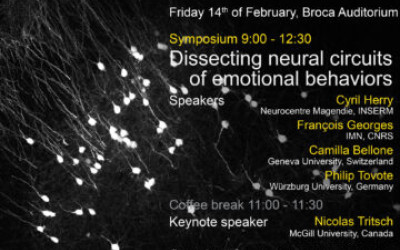
Cyril Herry, Inserm, Neurocentre Magendie
Neuronal representations of defensive states in prefrontal networks
Coping with threatening situations requires both identifying stimuli predicting danger and selecting adaptive behavioural responses in order to survive. The dorsomedial prefrontal cortex (dmPFC) is a critical structure involved in the regulation of threat-related behaviour. Yet, it is still unclear how threat-predicting stimuli and defensive states are associated within prefrontal networks to successfully drive adaptive responses. I will present data collected in mice submitted to a behavioral paradigm combining active and passive defensive behaviors in which we performed extracellular recordings, neuronal decoding approaches, and manipulations of specific interneuronal cell populations. Overall, these data indicate that while the dmPFC encodes dynamically danger and specific threat representations, these specific defensives states are tightly controlled by prefrontal interneuronal activities. Our data unveil the neuronal geometry by which dmPFC networks represent associated threat-predicting stimuli to appropriately drive aversive behaviors.
In the frame of Yoni Couderc’s PhD defense
Organizers :
Yoni Couderc & Anna Beyeler
Neurocentre Magendie




 Facebook