Team News


Sort by


Hottopic
01/07/2026 13h15
Laura Picot from Desmedt's lab will give a presentation entitled 'Prevention of PTSD Through Episodic Memory Stimulation Prior Traumatic Event: A translational approach' Please join us in the conference room, or via Zoom: https://u-bordeaux-fr.zoom.us/j/88458941797


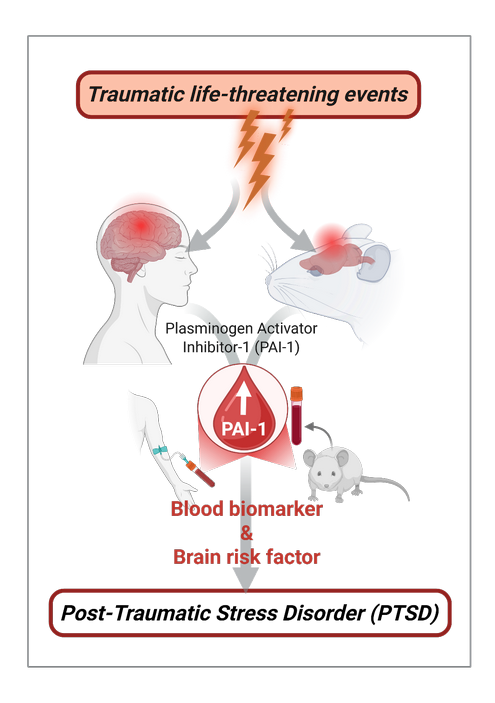
Post-traumatic stress disorder (PTSD) is a severe stress-related psychiatric condition triggered by traumatic life-threatening events, characterized notably by an altered memory profile. Although clinically well-documented, no specific biomarker exists. This translational study identifies plasminogen activator inhibitor-1 (PAI-1) as a brain risk factor for PTSD, thereby supporting its potential as a blood-derived biomarker. Mice with genetically ablated PAI-1 were protected from developing a PTSD-like memory profile. Conversely, mice exhibiting PTSD-like cognitive impairment showed increased blood PAI-1 levels, correlating with their profile severity. In the brain, PAI-1 levels were specifically increased in the dorsal hippocampus, a key region for cognitive functions and in the etiology of PTSD. Finally, a longitudinal study of soldiers revealed that those developing PTSD symptoms exhibit rising blood PAI-1 levels over a 12-month period. Its significant association with various indicators of PTSD-related psychological distress attests to PAI-1's potential as a blood biomarker and brain therapeutic target for PTSD.


Pièces jointes


The Brain & Behavior Research Foundation (BBRF) today announced it will award $1 million in Distinguished Investigator Grants to 10 senior scientists conducting innovative research in neurobiological and behavioral science.

The $100,000, one-year grants will support studies focused on critical mental health challenges, including depression, autism spectrum disorder, PTSD, bipolar disorder, schizophrenia, cocaine use disorder, and chronic cannabis use. The awards are funded by the WoodNext Foundation and mark the third year of a five-year, $5 million commitment to support BBRF’s Distinguished Investigator Grants program.

Aline Desmedt, Ph.D., NeuroCenter Magendie U1215 (INSERM, France), has developed an animal model that reproduces in mice the two memory components of PTSD: traumatic hypermnesia—the intense, involuntary, and recurrent re-experiencing of traumatic memories, often presenting as flashbacks or intrusive thoughts; and contextual amnesia, i.e., remembering details or events but forgetting the surrounding circumstances. This distinguishes PTSD-like memory from normative fear memory. This project seeks to identify neural mechanisms underlying the switch to and from pathological (PTSD-like) to normative fear memories. In animal models, the team will investigate the fate and representation of the “memory engram” during the formation, prevention, and normalization of trauma representation. The aim is to determine the extent to which a memory trace is transformed when (re)contextualized traumatic memory is normalized, shedding light on neurobiological mechanisms that could inform development of new therapeutic and preventive strategies.



General informations
30/06/2025


Hottopic
25/06/2025 13h45
Desmedt team - TBD


Hottopic
24/01/2024 13h45
Flávia Simoes from Desmedt's lab will give a presentation entitled "Mechanisms contributing to the stability of connectivity between engram cells". Please join us in the conference room of the CGFB building, or via https://u-bordeaux-fr.zoom.us/j/88458941797.