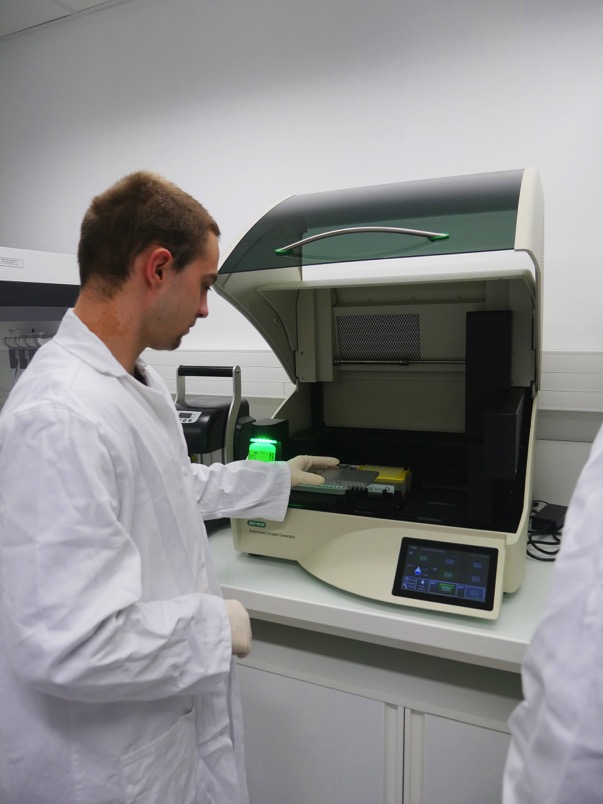
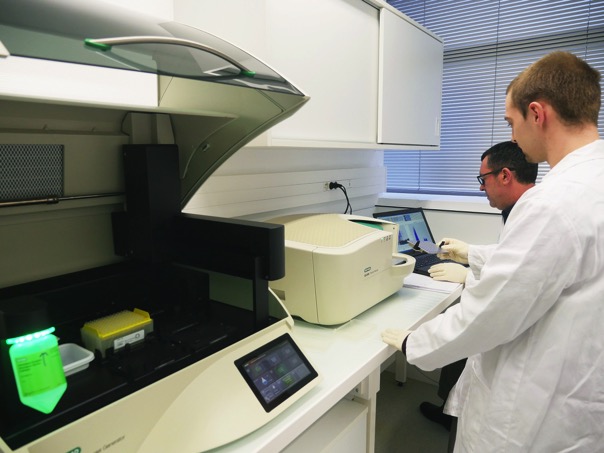
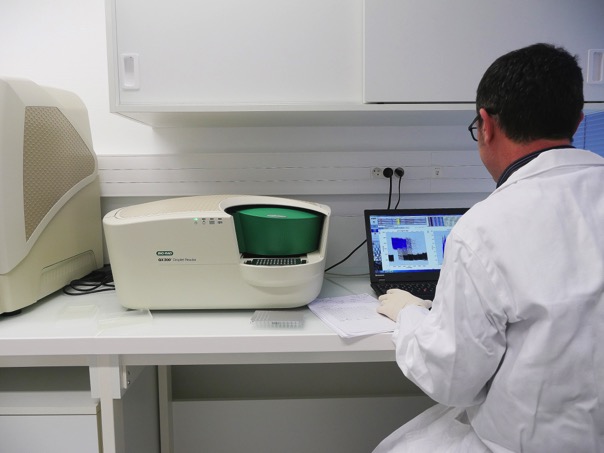
The 3rd generation PCR exploits the digital PCR technique: it is a microfluidic PCR technique based on sample partitioning. Fractionated into 20,000 droplets by water-oil emulsion, the samples are absolutely quantified from the smallest quantities.
Thanks to funding from Inserm, the Neurocentre Magendie equipped itself with the Bio-Rad Droplet digital PCR (ddPCR) in autumn 2016 and has since developed protocols for quantifying viral stocks, gene expression and quantification at the isolated cell level. Come and try it out!
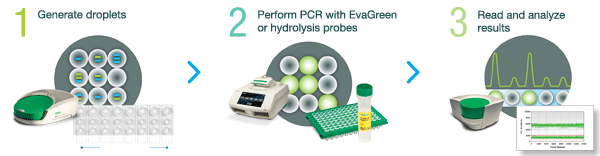
The 3rd generation PCR by ddPCR consists in the absolute quantification of samples without standard range in EvaGreen technology or fluorescent probes. The PCR technique used is a microfluidic technique based on the partitioning of samples into 20,000 droplets by water-oil emulsion. The matrices present in each of the individual droplets are then amplified by PCR and the number of copies/µl is calculated using Poisson's statistical law.
The advantages of ddPCR compared to qPCR are numerous :
- It allows absolute quantification: exact title in number of copies per µl. It is no longer necessary to establish a standard curve beforehand (Gene expression by direct ratio not ∆∆Ct).
- It is more sensitive: it allows the detection of rare mutations, works with degraded RNAs and is less sensitive to inhibitors.
- It is more precise, +/- 10% accuracy i.e. 0.15 Ct. It is also no longer necessary to make technical replicas.
- Absolute quantification: gene expression (visualisation of small variations in expression and from small quantities of material: single cell), quantification of NGS libraries, quantification of viral and mid-RNA stocks.
- Analysis of the variation in the number of copies (CNV).
- Detection of rare events (up to 0.001% mutants).
NEUROCENTRE MAGENDIE - U1215
146, rue Léo Saignat
33077 Bordeaux cedex
France

Thierry Leste-Lasserre, head of the transcriptome platform
thierry.leste-lasserre@inserm.fr
Phone +33 (0)5 57 57 36 67, Fax +33 (0)5 57 57 36 69