Team News


Sort by


Hottopic
25/05/2022 10h45
Marie GLEIZES from Montcouquiol-Sans' lab will give a presentation entitled "Consequences of early Vangl2 deletion on synaptic transmission at Mf-CA3 synapses in EMX1-Vangl2-/- mice" join using https://teams.microsoft.com/l/meetup-join/19%3ameeting_MmVhZGE0NzEtMTcwYS00Mzk4LThiN2QtMTMzNmRiMzIyNDg3%40thread.v2/0?context=%7b%22Tid%22%3a%2299dde8fb-92f6-414d-bc5e-44ffa3e2419c%22%2c%22Oid%22%3a%2201a1a834-947e-41cf-9a45-f8b29ebcb957%22%7d


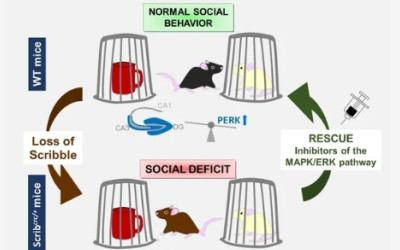
Scribble Controls Social Motivation Behavior through the Regulation of the ERK/Mnk1 Pathway
Maïté M. Moreau, Susanna Pietropaolo, Jérôme Ezan, Benjamin J. A. Robert, Sylvain Miraux, Marlène Maître, Yoon Cho, Wim E. Crusio, Mireille Montcouquiol, Nathalie Sans
Cells. 2022-05-10; 11(10): 1601
DOI: 10.3390/cells11101601

Social behavior is a basic domain affected by several neurodevelopmental disorders, including ASD and a heterogeneous set of neuropsychiatric disorders. The SCRIB gene that codes for the polarity protein SCRIBBLE has been identified as a risk gene for spina bifida, the most common type of neural tube defect, found at high frequencies in autistic patients, as well as other congenital anomalies. The deletions and mutations of the 8q24.3 region encompassing SCRIB are also associated with multisyndromic and rare disorders. Nonetheless, the potential link between SCRIB and relevant social phenotypes has not been fully investigated. Hence, we show that Scribcrc/+ mice, carrying a mutated version of Scrib, displayed reduced social motivation behavior and social habituation, while other behavioral domains were unaltered. Social deficits were associated with the upregulation of ERK phosphorylation, together with increased c-Fos activity. Importantly, the social alterations were rescued by both direct and indirect pERK inhibition. These results support a link between polarity genes, social behaviors and hippocampal functionality and suggest a role for SCRIB in the etiopathology of neurodevelopmental disorders. Furthermore, our data demonstrate the crucial role of the MAPK/ERK signaling pathway in underlying social motivation behavior, thus supporting its relevance as a therapeutic target.


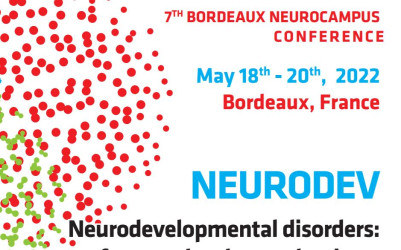
Neurodevelopmental disorders: from molecular mechanisms to social inclusion.
18-22 May 2022.

Neurodevelopmental disorders are a group of different conditions in which the development of the central nervous system is disrupted and which often have lifelong consequences. This brain dysfunction can manifest itself in neuropsychiatric problems (autism spectrum disorders, schizophrenia, Fragile X syndrome, Down's syndrome...) or in impaired motor function, learning, language or non-verbal communication. Many developmental processes can go awry, sometimes simultaneously, affecting the generation of an appropriate diversity of neuronal cell types, their migration to the correct sites in the brain and the establishment of accurate connectivity with target cells, leading to complex brain and sensory dysfunctions and neurological diseases.
During this three-day symposium, experts from different fields of developmental neuroscience, human neuropsychology, epidemiology, brain imaging, and genetics and epigenetics, as well as clinicians, will discuss the current state of research on neurodevelopmental disorders and its challenges for human health. By integrating neurodevelopmental perspectives with basic, translational and clinical approaches, this meeting will foster discussion and exchange, as well as a new understanding of the complexity of these disorders.


Scientific commitee
Anouck AMESTOY ; INCIA / Centre hospitalier Charles Perrens
Jean-René CAZALETS ; INCIA
Sophie LAYÉ ; Nutrineuro
Mireille MONTCOUQUIOL ; Neurocentre Magendie
Nathalie SANS ; Neurocentre Magendie

Documentation: PDF

More details / registration
https://spring-brainconf.u-bordeaux.fr/


Pièces jointes


General informations
25/04/2022


From the bench to the clinic: a new treatment for chronic neuropathic pain supported by SATT Nouvelle Aquitaine.

Chronic neuropathic pain is associated with nerve damage and affects 8% of the French population. With the exception of so-called tricyclic antidepressants (TCAs) or serotonin and noradrenaline reuptake inhibitors (SNRIs), which are only partially effective, there is no effective treatment without serious side effects. However, antidepressants of the "specific serotonin reuptake inhibitor" (SSRI) type are ineffective but have few side effects.

Researchers at IMN, in collaboration with the CERVO research centre in Quebec, have identified the cause of this inefficiency. It is therefore proposed to combine these inhibitors with a molecule that restores the normal functioning of the serotonin system involved. This work has been the subject of a priority European patent application by the co-inventors, Franck Aby, Pascal Fossat, Rabia Benazzouz and Yves De Konninck. They received support from the New Aquitaine region's technology transfer and acceleration company (SATT), Aquitaine Science Transfert (AST).

AST is providing 450,000 euros in funding for two years for the maturation project led by Franck Aby and the "Monoamines Parkinson and Pain (M2P)" team at IMN led by Abdelhamid Benazzouz and Pascal Fossat.


The Planiol-Inner Wheel Foundation Young Investigator Award 2021 has been awarded to Dr. Marion TIBLE for her work on inflammation and cell death in Alzheimer's disease.

Awarded research work: At the Brain and Spinal Cord Institute (ICM), Dr. Marion TIBLE has explored pathways complementary to the amyloid protein pathway by linking it to other features of Alzheimer's disease, including inflammation and neuronal death. She focused on the PKR enzyme protein: using several mouse models, she showed that this enzyme was central to the inflammatory and apoptotic mechanisms and transferred this discovery to humans.

Current situation: Now, within the Neurocentre Magendie in Bordeaux, Dr Marion TIBLE is pursuing her activity by investigating the role of iron in neuronal loss following a stroke, using new medical imaging techniques and innovative ultrasound procedures. See summary below.

Summary of work:

Ischemic stroke (iStroke) is one of the leading causes of disability in France and has a significant economic and societal cost. Stroke is due to the occlusion of a cerebral artery resulting in lesions, called ischemic, in the area deprived of oxygen. The current treatment strategy is rapid intervention to try to restore circulation to the area affected by the stroke. Unfortunately, not all patients can benefit from this and, among those who do, residual disability may remain significant. Therefore, there is a need to develop alternative approaches to protect the brain during and after stroke. It has previously been shown that stroke can exert effects at a distance from the acute injury, in regions distant from but connected to the initial injured area, a phenomenon described as "secondary neurodegeneration. These changes progressively evolve over months or even years, allowing treatment beyond the initial emergency. However, this therapeutic intervention faces several challenges: it is currently not established (1) that changes remote from stroke are clinically relevant, and (2) if they are, that a specific cellular mechanism can be targeted to prevent neuronal death in affected areas.

In recent years, the team I joined has made important contributions to this field through approaches using in vivo MRI (magnetic resonance imaging), a non-invasive, side-effect-free method commonly used in the clinic and pre-clinical setting. Using R2*, a quantitative MRI technique directly related to iron content, she was the first to demonstrate, directly in patients, that there was a progressive accumulation of iron in remote brain regions initially spared but connected to the site of stroke. The greater the amount of iron present in these regions, the greater the clinical impact (functional, cognitive, neuropsychological).

As these results suggest a remote damage, aggravated by the presence of iron, I am now undertaking an in-depth study of the course of this phenomenon and its relationship with neuronal loss. I was not only able to reproduce the human observations, but also to show that the progressive increase of iron preceded and was strongly predictive of neuronal loss. These data support our hypothesis that iron present in disconnected regions would accelerate cell death, increase inflammation and thus, be responsible for secondary symptoms aggravating the pathology. The present project aims to study the mechanisms of this neuronal death and the effects of drugs aimed at suppressing and/or decreasing the iron load in order to treat the secondary symptoms of stroke, to improve the recovery of the patients and to discover new biomarkers allowing an adequate post-stroke follow-up.

Translated with www.DeepL.com/Translator (free version)


Hottopic
24/11/2021 10h00
Shri SESHADRI from Montcouquiol-Sans' lab will give a presentation entitled 'The Role of MPDZ in auditory hair cell development and hydrocephalus' - Hybrid session: Teams meeting

General informations
22/11/2021
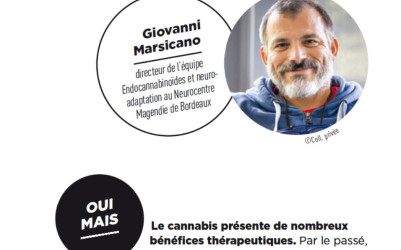
Giovanni Marsicano interviewed by Inserm magazine: Medical cannabis, a smoke screen?

The French National Agency for the Safety of Medicines and Health Products (ANSM) has been running an experiment on so-called "medical" cannabis since March 2021, for two years. This consists of authorising doctors in the 215 participating facilities to prescribe cannabis-based products, such as oral pipette oils or inhalation preparations, to 300 volunteers. Five indications are concerned: neuropathic pain refractory to accessible therapies; certain forms of severe and drug-resistant epilepsy; symptoms linked to cancer or its treatments; palliative care; and finally pain linked to multiple sclerosis and other diseases of the central nervous system. Is the issue exclusively medical, or does this treatment of cannabis herald a softening of public policy in favour of this drug? And if it is medical, should cannabis be seen as a medicine like any other, or just a smokescreen in a context of impotence to treat chronic ailments?

Giovanni Marsicano:
Cannabis has many therapeutic benefits. In the past, due to the lack of effective medicines, many patients have tried it to relieve their symptoms... with, for some, spectacular results.
However, when it proved ineffective or deleterious, patients said nothing - since its use was illegal. This creates a clear bias in the assessment of the benefits of this substance. In fact, the positive effects are often outweighed by other
by others. For example, cannabinoids3 are analgesic but inhibit the body's ability to initiate movement. This cataleptic effect can be dangerous! More broadly, the effect of cannabis depends very much on the individual. A small but real proportion of teenage users will have psychotic episodes, either immediately or in adulthood. Other users experience memory loss or cognitive
Other users experience memory loss or long-term cognitive deficits.
And 10-20% suffer from uncontrolled use, indicating a form of dependence - even though, compared to nicotine, alcohol or opiates, cannabis is one of the least addictive drugs of abuse. Finally, the effect depends on the dose of cannabinoids. THC almost always has biphasic effects: above a certain threshold, its effects are reversed. It can increase or inhibit locomotion, suppress appetite and increase anxiety, and even cause social withdrawal. We have shown that excess THC weakens the metabolism of astrocytes - the star-shaped cells of the central nervous system - which then convert less glucose into lactate, the main source of energy for
neurons. Overall, patients need research to progress. But the dozens of active compounds present in cannabis undoubtedly have cross-over effects, known as "entourage" effects, which THC or CBD do not provide separately: sometimes it is the plant itself that heals!


Pièces jointes


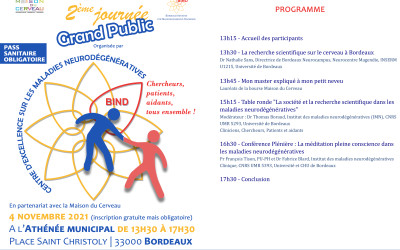
The Centre of Excellence on Neurodegenerative Diseases of Bordeaux and the association Maison du Cerveau will hold their 2nd General Public Day on the theme: "Researchers, patients, carers: all together!

This day is part of the promotion of exchanges with users and associations. It is organised in partnership with and with the support of patients' associations (France Alzheimer Gironde, France Parkinson Gironde, AMMI, France AVC Gironde, ACMH, FRC, etc.).

Registration is free but mandatory:
- via the following form: Fill in the form
- or by email to bind@u-bordeaux.fr (indicating: Name, First name, Email, Phone)
Programme

13:15 - Welcome of the participants

13h30 - Scientific research on the brain in Bordeaux
Dr Nathalie Sans, Director of Bordeaux Neurocampus, Neurocentre Magendie, INSERM U1215, University of Bordeaux

13:45 - My master's degree explained to my little nephew
Winners of the Maison du Cerveau grant

15:15 - Round table "Society and scientific research in neurodegenerative diseases
Moderator: Dr Thomas Boraud, Institute of Neurodegenerative Diseases (IMN), CNRS UMR 5293, University of Bordeaux
Clinicians, Researchers, Patients and Carers

16:30 - Plenary lecture: Mindfulness meditation in neurodegenerative diseases
Pr François Tison, PU-PH and Dr Fabrice Blard, Institute of Clinical Neurodegenerative Diseases, CNRS UMR 5293, University and University Hospital of Bordeaux

17:30 - Conclusion

Registration by mail : bind@u-bordeaux.fr


Pièces jointes


Seminars
21/09/2021 09h00
Synapse Day

Meeting room: Centre Broca Nouvelle-Aquitaine

Registration here: https://www.bordeaux-neurocampus.fr/event/synapse-day/

Program
9:00 Christoph Schmidt-Hieber (Institut Pasteur, Paris)
SynapticA and circuit basis of distinct memory formation in the hippocampus

9:45 Noémie Depret (Neurocentre Magendie, Montcouquiol-Sans team, Bordeaux)
Vangl2 regulates hippocampal mossy fiber-CA3 synapse formation and morphofonctional plasticity

10:05 Nicolas Chenouard (IINS, Bordeaux)
Imaging the activity of subcortical-cortical axonal projections during associative learning

10:25-10.55 Coffee break

10:55 Morgane Lebon-Jego (IMN, Bordeaux)
Dopaminergic control of the primary motor cortex microcircuits during motor skill learning

11:25 Camille Quilgars (INCIA, Bordeaux)
Transient motor training in newborn mice reshapes transcriptome and synaptic plasticity in motoneurons

11:45 Konstantina Liouta (IINS, Bordeaux)
TBA

12:05 Harold Gillavry (Utrecht University, Netherlands)
CRISPR/Cas9-mediated genome editing tools to resolve the dynamic nanoscale organization of endogenous proteins at excitatory synapses

12:50-14:30 Lunch

14:30 Stéphane Bancelin (IINS, Bordeaux)
in vivo 3D-STED microscopy in the hippocampus

15:00 Angela Getz (IINS, Bordeaux)
Development of an experimental model for high-resolution imaging and manipulation of endogenous AMPA receptor surface mobility during synaptic and behavioral plasticity

15:20 Mathieu DiMiceli (Nutrineuro, Bordeaux)
Dietary polyunsaturated fatty acids modulate endocannabinoid-mediated synaptic plasticity in the nucleus accumbens

15:40 Daniel Jercog (Neurocentre Magendie, Herry team, Bordeaux)
Prefrontal population coding of defensive behaviors

16:00 Maria-Cecilia Angulo (Institut de Psychiatrie et Neurosciences, Paris)
Myelination of parvalbumin interneurons shapes cortical inhibition